Why Proper Drainage Is Critical for Pavers in Florida
A beautiful paver driveway, patio, walkway, or pool deck can
completely transform the appearance of a Florida home.
But what happens when it rains?
That question is just as important as choosing the color, pattern, or style of the pavers.
In Southwest Florida, outdoor surfaces must handle intense seasonal rainfall, irrigation, humidity, storm runoff, and water coming from roofs, landscaping, and nearby hardscape areas.
If water is not managed properly, homeowners may eventually notice:
- Standing water
- Sand washing out
- Erosion
- Sinking pavers
- Uneven sections
- Water collecting near the home
- Repeated maintenance problems
- Algae or organic growth in damp areas
This is why proper drainage should be considered before pavers are installed, not after a problem appears.
A good paver installation is not only about how the finished surface looks.
It is about how the entire area functions.
Here is what Florida homeowners should know about drainage, grading, water movement, and how they can affect the long-term performance of a paver installation.
Why Is Drainage So Important in Florida?
Florida receives significant rainfall, particularly during the wet season.
A short storm can place a large amount of water onto:
- Roofs
- Driveways
- Patios
- Pool decks
- Walkways
- Landscaping
- Neighboring surfaces
All of that water has to go somewhere.
When a property is properly planned, water should move in an intended direction and away from areas where it could create problems.
When drainage is poor, water may repeatedly collect in low spots or flow across areas that were not designed to handle it.
Over time, this can affect both the visible pavers and the materials underneath them.
Grading Comes Before Drainage
One of the most important concepts homeowners should understand is grading.
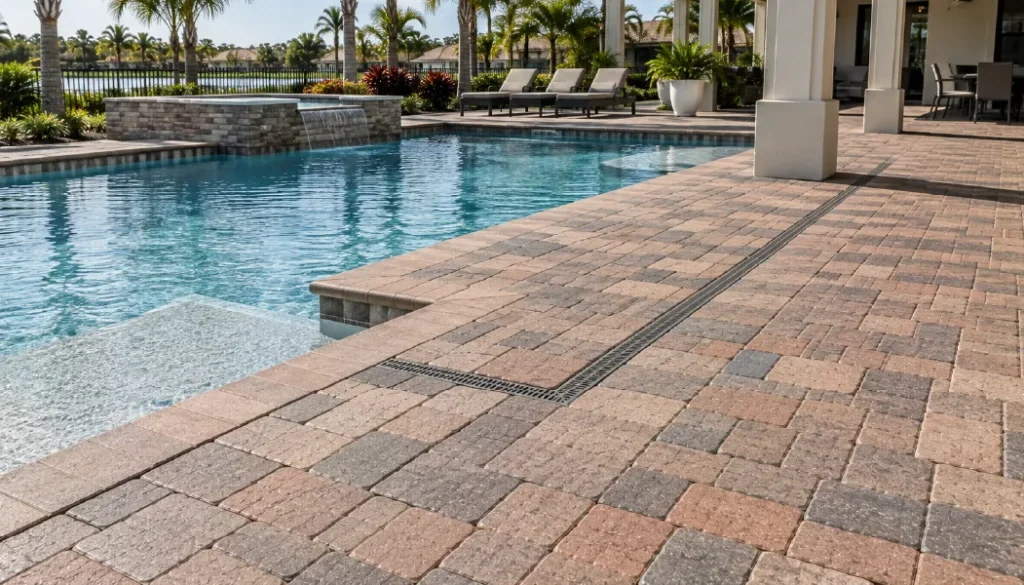
Grading refers to how the elevation and slope of the surface are planned so water moves in the correct direction.
A paver surface may look nearly flat to the eye while still having enough slope to direct water.
The proper grading strategy depends on the specific property.
A contractor may need to consider:
- Garage elevation
- Front door thresholds
- Sidewalks
- Street elevation
- Existing drains
- Landscape beds
- Pool structures
- Neighboring surfaces
- Property boundaries
- Downspouts
- Existing concrete
- Adjacent walkways
The goal is not simply to make water “run downhill.”
It is to determine where that water should safely go.
What Happens When Pavers Are Installed Without Proper Drainage?
Poor drainage can create several types of problems.
Some appear immediately.
Others may take months or years to become noticeable.
Standing Water
If an area is too low or does not have adequate slope, water may collect after rain.
A small amount of temporary surface moisture after a storm can be normal.
But recurring puddles that remain in the same location may indicate an elevation or drainage issue.
Erosion
Water moving through or around an installation can gradually carry away supporting material.
If enough support is lost, sections of pavers can begin to settle.
Joint Sand Loss
If water repeatedly moves across certain areas with enough force, homeowners may notice joint material disappearing faster in those locations.
Sinking or Uneven Pavers
Erosion, poor drainage, and repeated saturation can contribute to settlement when the supporting system is compromised.
Organic Growth
Areas that remain damp may be more prone to algae and other organic buildup.
This can make the surface harder to maintain and, depending on the condition, may also affect traction.
1. Water Pooling on a Paver Driveway
Driveways are one of the most common places homeowners notice drainage problems.
After a storm, look at how water moves across the surface.
Does it:
- Flow toward the street?
- Move toward a drain?
- Collect near the garage?
- Sit in the middle of the driveway?
- Run toward landscaping?
- Collect along the edges?
The correct answer depends on how the property was designed.
What matters is whether the water is moving intentionally.
Water collecting near a garage or home can be particularly concerning because the driveway may be directing runoff toward the structure rather than away from it.
A professional installer should evaluate those elevations before beginning the project.
2. Driveway Edges Are Vulnerable to Erosion
The edges of a paver driveway deserve attention because they are transition points between the hardscape and surrounding soil or landscaping.
If water repeatedly flows off the same edge, soil may begin to wash away.
As material disappears along the perimeter, the edge can lose support.
Homeowners may eventually notice:
- Border pavers moving
- Pavers leaning
- Sand escaping
- Gaps increasing
- Edge settlement
Proper edge support and thoughtful drainage can help reduce these problems.
A beautiful border will not perform well if the area beside it is constantly eroding.
3. Roof Runoff Can Affect Pavers
Homeowners sometimes focus only on the water falling directly onto their driveway or patio.
But roof runoff can be much more concentrated.
A roof collects water from a large area and directs it toward gutters, downspouts, or drip lines.
If a downspout empties directly onto or beside a paver installation, a large amount of water may repeatedly enter one small area.
That can contribute to:
- Erosion
- Sand loss
- Staining
- Organic growth
- Settlement
- Water pooling
If sinking pavers repeatedly appear near a downspout, it is worth looking at the drainage source instead of repairing the surface over and over.
4. Landscaping Can Change Water Flow
Landscaping and pavers need to work together.
Changes to landscape beds, soil levels, curbing, irrigation, or plantings can alter how water moves around the property.
For example, adding soil to a planting bed may raise the surrounding grade and cause water to move toward the pavers.
A landscape border may trap water.
Irrigation may repeatedly saturate one section.
Tree roots may also change surrounding soil conditions.
When drainage problems appear after landscaping work, the paver installation itself may not be the only factor.
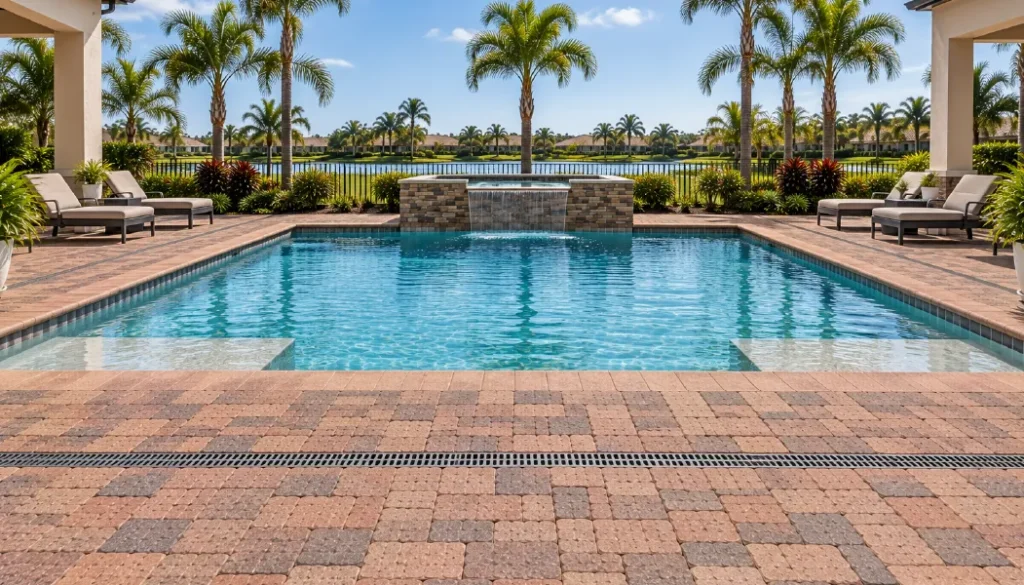
5. Pool Deck Drainage Requires Special Planning
Pool decks are exposed to water even when it is not raining.
Water can come from:
- Swimming
- Pool cleaning
- Rain
- Irrigation
- Hose use
- Outdoor showers
- Landscaping
The deck needs to be planned so water moves safely away from structures and does not create persistent low spots.
Pool decks also have additional considerations because people often walk barefoot and the area may remain wet.
A drainage issue around a pool can therefore become both a maintenance problem and a usability concern.
6. Patios and Walkways Need Drainage Too
Drainage is not only a driveway issue.
Patios and walkways can also develop problems when water becomes trapped.
A patio located between a home and landscaping may have limited places for water to go.
A walkway may collect water if surrounding soil sits higher than the paver surface.
Over time, homeowners may notice:
- Low spots
- Moss or algae
- Joint loss
- Edge erosion
- Uneven pavers
These smaller areas deserve the same level of planning as a larger driveway.
Are Pavers Permeable?
This is an important question because there is a common misconception that all paver installations automatically allow water to drain directly through the surface.
That is not necessarily true.
There is a difference between:
Standard interlocking pavers and Permeable paver systems
A permeable system is specifically designed to allow water to pass through wider joints and into an engineered base below.
A standard paver installation may allow some moisture into the joints, but it should not be treated as a dedicated stormwater drainage system unless it was specifically designed that way.
For most residential paver projects, surface grading and drainage remain extremely important.
Can Sealer Fix a Drainage Problem?
No.
Sealer is a surface treatment.
It may be part of a maintenance plan, but it will not correct:
- Improper slope
- Sinking pavers
- Erosion
- Poor base preparation
- Water collecting in a low spot
- A downspout directing water incorrectly
If water is pooling or pavers are settling, the underlying cause needs to be addressed.
Applying sealer over the surface will not change the elevation or stop erosion underneath the installation.
Why Drainage and Base Preparation Work Together
Drainage problems become more serious when the supporting base is weak.
A properly prepared base helps support the pavers and distribute loads.
But even good base preparation can be affected if water is repeatedly eroding or washing material away.
Likewise, excellent drainage cannot compensate for a poorly compacted base.
A long-lasting installation depends on both.
That is why professional paver installation should consider the complete system:
- Existing soil
- Excavation
- Base material
- Compaction
- Grading
- Drainage
- Edge restraint
- Bedding
- Pavers
- Joint material
Every layer contributes to the final result.
How Do You Know If You Have a Drainage Problem?
Pay attention after heavy rain.
Walk the property and look for patterns.
Possible warning signs include:
- Water remains in the same puddle after every storm
- Pavers are beginning to sink near a wet area
- Sand repeatedly washes out
- One edge of the driveway is eroding
- Water collects near the garage
- Water flows toward the house
- Algae grows heavily in one consistently damp location
- A section stays wet much longer than surrounding areas
- A drain appears to be sitting too high or too low
- Water from a downspout crosses the paver surface
One symptom does not automatically mean the installation has failed.
But repeated patterns deserve attention.
Can Drainage Problems Be Fixed After Pavers Are Installed?
Often, yes.
The appropriate repair depends on what is causing the issue.
Solutions may involve:
- Lifting and re-grading a localized paver area
- Correcting low spots
- Repairing settled sections
- Restoring eroded edges
- Redirecting roof runoff
- Adjusting surrounding landscaping
- Installing or correcting drainage components
- Addressing base material where support has been lost
Some issues may be relatively localized.
Others may require a more comprehensive redesign of the area.
The important part is diagnosing the problem correctly before deciding on the repair.
Why the Lowest Paver Installation Quote Can Become Expensive Later
Drainage is one of the reasons homeowners should compare more than just the final price when selecting a paver contractor.
A lower quote may be attractive, but ask what is included in the preparation.
Questions worth asking include:
- How will the existing area be graded?
- Where will water go?
- Is demolition included?
- What base preparation is included?
- How are edges handled?
- Are drainage conditions being evaluated?
- How are transitions to the garage, sidewalk, or street handled?
If these questions are ignored during installation, the homeowner may pay for corrections later.
A paver driveway should not only look good on installation day.
It should be planned to function properly during Florida’s rainy season as well.
What Should a Professional Paver Contractor Evaluate?
Before installation, a contractor should look at more than square footage.
Depending on the project, the evaluation should consider:
- Existing elevations
- Surface conditions
- Soil
- Drainage
- Garage and doorway elevations
- Street or curb transitions
- Existing drains
- Landscaping
- Downspouts
- Irrigation
- Pool areas
- Nearby hardscapes
- Access to the project
These details help determine the appropriate installation plan.
Frequently Asked Questions
Is standing water on pavers normal after rain?
A paver surface may remain wet temporarily after rain, but recurring puddles that consistently form in the same low spot may indicate a grading, settlement, or drainage issue.
Can water underneath pavers cause them to sink?
Water can contribute to erosion or loss of support if drainage conditions allow base or surrounding material to move. Sinking should be evaluated to determine the actual cause.
Do pavers need a slope?
Paver surfaces generally need appropriate grading so water moves in the intended direction. The correct slope depends on the property, elevations, and drainage design.
Will water drain through the joints between pavers?
Some moisture may enter standard paver joints, but a standard interlocking paver installation should not automatically be considered a permeable drainage system. True permeable paver systems are specifically designed for that purpose.
Can a sunken area be re-leveled?
Often, yes. The affected pavers may be removed, the underlying problem corrected, the base restored, and the pavers reinstalled at the proper elevation.
Can poor drainage wash out joint sand?
Repeated concentrated water flow can contribute to joint material loss. If sand continually disappears from the same location, the source of the water should be investigated.
Should drainage be planned before installing a paver driveway?
Yes. Existing elevations, runoff, nearby structures, and water flow should be considered as part of the installation planning process.
A Great Paver Installation Should Look Good and Work Properly
Homeowners naturally focus on the visible parts of a project.
Color matters.
Pattern matters.
Borders matter.
The finished appearance matters.
But drainage, grading, base preparation, and compaction are what help that beautiful finished surface perform over time.
In Southwest Florida, where heavy rainfall is part of life, water should never be treated as an afterthought.
A professional paver contractor should consider how water will move through and around the property before the installation begins.
And if you already have pavers that are collecting water, sinking, or losing joint material, the goal should be to identify why the problem is occurring—not simply hide the symptom.
Having Drainage or Paver Problems?
Master Z Pavers provides professional paver installation, repair, re-leveling, restoration, maintenance, and sealing throughout Southwest Florida.
We can evaluate your existing pavers, drainage conditions, settlement, and surrounding areas and help determine the appropriate next step.
Whether you are planning a new driveway, patio, pool deck, or walkway—or trying to correct a problem with an existing installation—we are here to help.
Request a Free Estimate
Call Master Z Pavers at (239) 877-5447.
Get A Free Estimate