How Often Should You Seal Pavers in Florida?
If you have a paver driveway, patio, walkway, or pool deck in Florida,
you’ve probably heard that your pavers should be sealed.
But how often should you actually do it?
There isn’t one schedule that works for every property.
Florida pavers are exposed to intense sunlight, heavy rain, humidity, vehicle traffic, pool water, landscaping, dirt, organic material, and year-round outdoor conditions. The type of paver, previous sealer, amount of traffic, exposure, drainage, and condition of the installation can all affect when resealing may be appropriate.
For that reason, homeowners should be cautious about automatically sealing their pavers simply because a certain number of years has passed.
The condition of the pavers matters just as much as the calendar.
Here’s what Southwest Florida homeowners should know about paver sealing,
how to recognize when pavers may need attention, and why proper preparation is so important.
how to recognize when pavers may need attention, and why proper preparation is so important.
Why Are Pavers Sealed?
Paver sealing can serve several purposes depending on the paver material and the sealing product used.
A professionally selected and applied sealer may help:
-
Protect the paver surface
-
Reduce the absorption of certain stains
-
Enhance or preserve appearance
-
Make routine cleaning easier
-
Help stabilize joint sand with certain sealing systems
-
Reduce weathering of the surface
-
Create a particular finish or appearance
Some homeowners want a more natural appearance, while others prefer an enhanced or richer-looking finish.
The important point is that not every paver, property, or existing installation should automatically receive the same product or treatment.
Before sealing, the condition of the pavers and any previous coatings should be evaluated.
So, How Often Should Pavers Be Sealed
in Florida?
You will often see general recommendations suggesting that pavers may need resealing every few years. That can be a useful starting point, but it should not be treated as a fixed rule.
A driveway receiving daily vehicle traffic and full Florida sun can experience very different conditions from a covered patio.
Likewise, a pool deck exposed to water, chemicals, sun, foot traffic, landscaping, and outdoor furniture has different maintenance requirements from a front walkway.
Instead of asking only:
“How many years has it been?”
homeowners should also ask:
“What condition are my pavers in right now?”
A professional evaluation can help determine whether the existing surface needs cleaning, joint maintenance, repair, restoration, sealer removal, resealing, or possibly no sealing work at all.
Florida’s Climate Makes Paver Maintenance Important
Southwest Florida is a demanding environment for exterior surfaces.
Pavers may be exposed to:
- Strong UV radiation
- High temperatures
- Heavy seasonal rain
- High humidity
- Tropical weather
- Standing moisture
- Algae and organic growth
- Landscaping debris
- Irrigation water
- Vehicle traffic
- Pool water and chemicals
These conditions don’t necessarily mean that pavers need to be constantly resealed.
They do mean that homeowners should regularly inspect and maintain outdoor hardscapes instead of waiting until deterioration becomes severe.
1. Sun Exposure Can Affect the Appearance of Pavers
Florida sunlight is intense.
Outdoor materials naturally experience weathering from prolonged UV exposure, and pavers are no exception.
Over time, homeowners may notice that the surface doesn’t look as vibrant as it once did.
However, a faded appearance doesn’t automatically mean another coat of sealer should immediately be applied.
First, determine what is causing the appearance.
The pavers may need cleaning. An older sealer may be deteriorating. There may be residue or contamination on the surface. Or the pavers may simply be experiencing normal weathering.
Applying new sealer over an improperly prepared surface can create additional problems rather than solving the original one.
2. Heavy Rain Can Affect Joints and Surrounding Areas
Florida’s rainy season can deliver large amounts of water in a relatively short period.
Over time, homeowners may notice joint material becoming lower or washing away in certain locations.
This is particularly important to investigate if the problem repeatedly occurs in the same area.
Joint loss can sometimes indicate more than routine maintenance.
Water may be moving across the surface in a particular way, drainage may need attention, or settlement may be changing how water travels through the area.
Simply adding more joint material without understanding why it keeps disappearing may not correct the underlying problem.
3. Traffic Matters
Not every part of a paver installation receives the same amount of use.
A driveway may experience:
- Cars entering and leaving every day
- Turning tires
- Oil or automotive fluids
- Delivery vehicles
- Landscaping equipment
A pool deck may experience:
- Frequent foot traffic
- Water
- Outdoor furniture
- Sunscreen
- Food and beverages
- Pool chemicals
A walkway may receive comparatively light use.
Because these areas experience different conditions, their maintenance schedules may also differ.
This is another reason a one-size-fits-all sealing schedule isn’t ideal.
Signs Your Pavers May Need Attention
Rather than waiting for a specific anniversary date, look at what your pavers are telling you.
Here are several signs that it may be time to have them professionally evaluated.
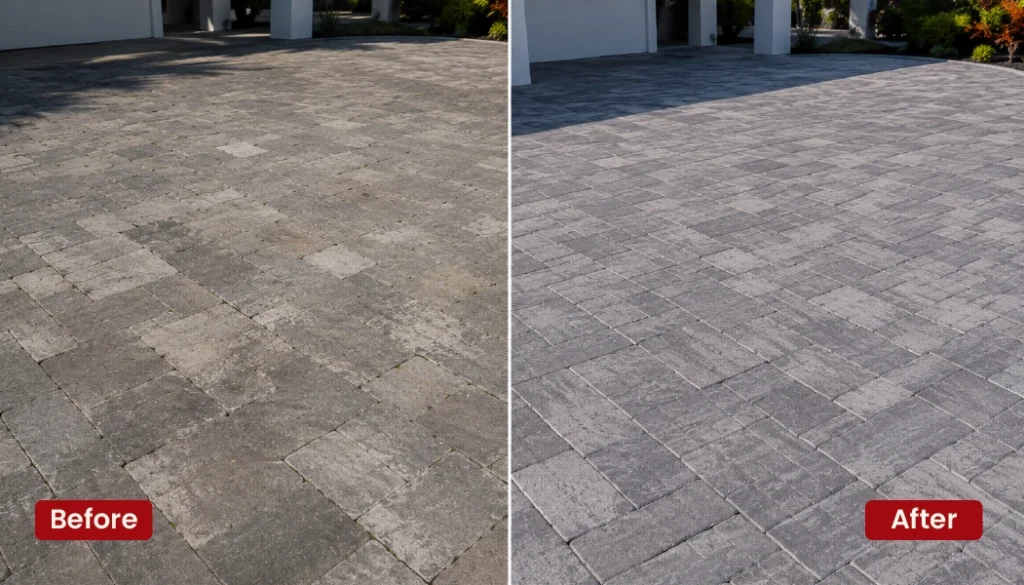
1. The pavers look dull or significantly different from when they were previously sealed
If the appearance has changed substantially, the existing sealer may have weathered.
That doesn’t automatically mean another coat should be applied, but it is a reason to inspect the surface.
2. Water no longer behaves the way it did after sealing
Depending on the paver and sealer system, you may notice changes in how water interacts with the surface as the previous treatment wears.
Again, this is only one indicator and shouldn’t be used by itself to determine whether resealing is appropriate.
3. Joint sand is noticeably low
If joints are losing material, maintenance may be required.
The cause should also be considered, particularly if the loss is concentrated in certain locations.
4. Weeds or organic growth are becoming more noticeable
Weeds, algae, mold-like growth, and organic material can become more visible as an outdoor surface requires maintenance.
These issues may require cleaning and joint maintenance before any sealing is considered.
5. Stains are becoming difficult to manage
Vehicle fluids, leaves, irrigation, food, beverages, and other materials can affect outdoor pavers.
Professional cleaning may improve the surface and provide an opportunity to assess whether additional protection is appropriate.
6. The previous sealer is peeling, whitening, hazing, or becoming uneven
This is particularly important.
If an existing coating is visibly failing, do not assume the solution is simply to apply another coat over it.
The existing product and surface condition should be evaluated first.
Can You Seal Pavers Too Often?
Yes, inappropriate or excessive application can create problems.
More sealer does not automatically mean more protection.
Applying products too frequently, using incompatible products, applying too much material, or coating a surface that has not been properly prepared can contribute to an undesirable finish.
Potential issues can include:
- Hazy appearance
- Whitening
- Uneven finish
- Excessive buildup
- Peeling or coating failure
- Trapped moisture-related appearance issues
- Areas that look different from one another
This is why paver sealing should be treated as a process rather than simply “putting something shiny on the driveway.”
Preparation Is One of the Most Important Steps
The final sealing result depends heavily on what happens before the sealer is applied.
Depending on the condition of the installation, preparation may involve:
- Inspecting the pavers
- Identifying previous coatings
- Checking for damaged or uneven areas
- Cleaning the surface
- Treating appropriate stains or organic growth
- Allowing sufficient drying
- Addressing joint material
- Evaluating weather conditions
- Selecting an appropriate sealing product
If the surface isn’t properly prepared, sealing can highlight existing problems rather than hide them.
A dirty paver does not become a clean paver because sealer was applied over it.
Likewise, sealing won’t correct a sinking paver, poor drainage, or an unstable base.
Those issues should be addressed separately.
Should Pavers Be Repaired Before They Are Sealed?
Generally, existing repair issues should be evaluated before the sealing process.
If pavers are:
- Sinking
- Rocking
- Uneven
- Separating
- Damaged
- Experiencing drainage problems
it makes sense to investigate those conditions first.
For example, imagine sealing an entire driveway and then discovering that a large section needs to be lifted to correct settlement.
The sequence of work matters.
Repair first. Prepare the surface properly. Then determine whether sealing is appropriate.
What About Sealing a Paver Pool Deck?
Pool decks require additional consideration because the surface is frequently wet and people may be walking barefoot.
The paver material, texture, existing condition, previous treatment, and sealing product all matter.
Slip resistance is particularly important.
Homeowners should not choose a pool-deck sealer solely because they like how glossy it looks in a photograph.
The product needs to be appropriate for the surface and application.
A professional should consider how the area is actually used.
Should a Paver Driveway Be Sealed?
A driveway is one of the most demanding paver applications because it receives vehicle traffic in addition to Florida’s outdoor exposure.
Sealing may be part of a driveway maintenance plan, depending on the pavers and desired outcome.
But maintenance should go beyond sealer.
Homeowners should also watch for:
- Low joint material
- Settlement
- Tire-related movement
- Stains
- Edge movement
- Drainage problems
- Cracked or damaged individual pavers
The advantage of a paver driveway is that many localized issues can potentially be repaired without replacing the entire surface.
Should You Seal Brand-New Pavers Immediately?
Not necessarily.
The correct timing depends on the specific paver, manufacturer recommendations, installation conditions, jointing system, efflorescence or other surface conditions, and the sealing product being considered.
Homeowners should avoid assuming that every new paver installation should receive sealer immediately after installation.
The installer or sealing professional should evaluate the materials being used and follow appropriate product and manufacturer requirements.
What Is Efflorescence?
Homeowners sometimes notice a whitish deposit on the surface of concrete pavers.
This may be efflorescence, which occurs when soluble salts migrate with moisture and become deposited at the surface.
Efflorescence should not automatically be mistaken for paver damage.
However, surface conditions should be properly evaluated and addressed before sealing.
This is another example of why preparation matters.
If you’re unsure what you’re seeing, it’s better to identify the condition before applying another product to the surface.
Can You Seal Pavers Yourself?
Paver sealer is available to consumers, so homeowners can technically attempt the project themselves.
The bigger question is whether the surface is suitable for sealing and whether the preparation, product selection, application rate, drying conditions, and weather conditions will be handled correctly.
Mistakes can become much harder and more expensive to correct after a coating has been applied.
Professional service can be particularly valuable when:
- Previous sealer already exists
- The surface has stains
- Pavers are uneven
- There is significant organic growth
- Joint sand is missing
- The existing coating is hazy or peeling
- You’re unsure which product was previously used
- A large driveway or pool deck is involved
Frequently Asked Questions About Paver Sealing in Florida
How often should you seal pavers in Florida?
There is no universal schedule for every paver installation. Many homeowners hear general recommendations of resealing every few years, but the actual timing should depend on the paver type, existing sealer, traffic, exposure, surface condition, and manufacturer or product recommendations.
How do I know if my pavers need to be resealed?
Look for changes in appearance, deterioration of the existing finish, low joint material, staining, or other signs that maintenance may be needed. A professional evaluation can help determine whether the surface needs cleaning, restoration, repair, resealing, or another treatment.
Will sealing stop weeds from growing between pavers?
Sealing and joint stabilization may help as part of an overall maintenance strategy, but no treatment should be presented as a permanent guarantee against weeds. Organic material and seeds can accumulate in joints over time.
Does sealing prevent pavers from fading?
A suitable sealing system may help protect or enhance the appearance of certain pavers, but no outdoor surface is completely immune to years of Florida sun and weather exposure.
Can old sealer be sealed over?
Sometimes an existing coating may be compatible with a new application, while in other situations it may require additional preparation or removal. The existing product and its condition should be identified before applying another coating.
Can sealing fix uneven pavers?
No. Sealing is a surface treatment. If pavers are sinking or becoming uneven, the cause should be investigated and repaired separately.
Protect Your Pavers the Right Way
Sealing can be an important part of paver maintenance, but timing, preparation,
and product selection matter
and product selection matter
Rather than automatically resealing because a certain amount of time has passed, look at the condition of your pavers and consider how the area is used.
A driveway exposed to daily vehicle traffic may have different needs than a covered patio. A pool deck has different considerations from a front walkway.
And if there are existing problems involving settlement, drainage, joint loss, or a failing previous coating, those issues should be identified before applying another layer of sealer.
Need Help With Your Pavers?
Master Z Pavers provides professional paver installation, repair, restoration, maintenance, and sealing services throughout Southwest Florida.
Whether your pavers need maintenance or you’re not sure what condition they’re in, we can evaluate the area and help determine the appropriate next step.
Call Master Z Pavers at (239) 877-5447 to request a free estimate.
Get A Free Estimate