
Pavers vs. Concrete Driveways in Florida: Which Is Better?
If you’re planning a new driveway or replacing an older one, one of the biggest decisions you’ll make is choosing the right surface. For Florida homeowners, the choice often comes down to two popular options: concrete or pavers.
Both can create a functional driveway, but they differ significantly in appearance, maintenance, repairability, installation, and how they respond to Florida’s climate.
In Southwest Florida, homeowners also have to consider intense sunlight, heavy seasonal rain, humidity, drainage, soil conditions, and year-round outdoor exposure. The material that works well in another part of the country may not always be the best choice for a Florida property. So, which is better for your home?
Let’s compare pavers vs. concrete driveways in Florida and look at the factors you should consider before making your decision.
What Is a Paver Driveway?
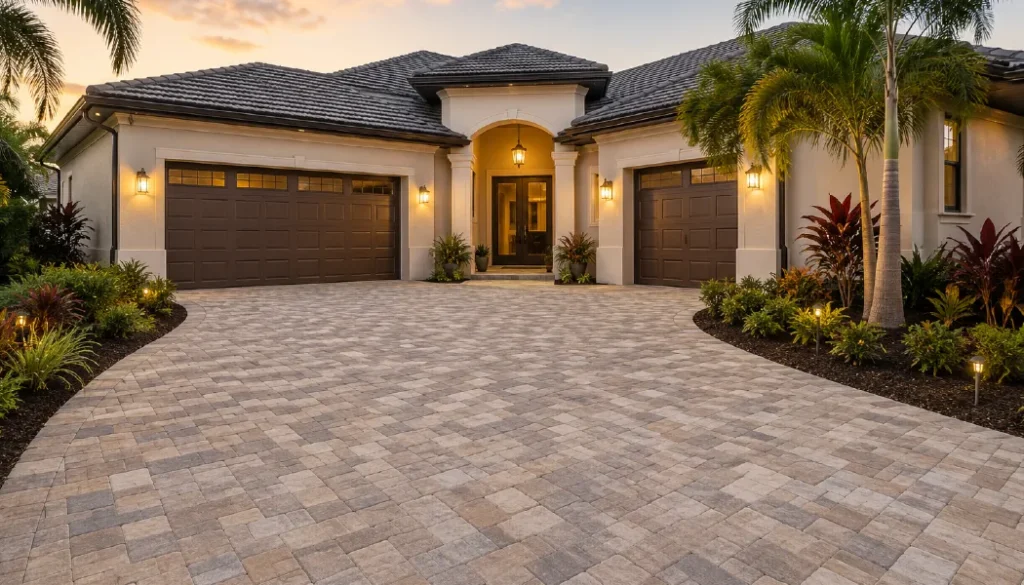
A paver driveway is constructed using individual interlocking paving units installed over a properly prepared and compacted base.
Pavers are available in many colors, shapes, textures, sizes, and patterns, allowing homeowners to create a driveway that complements the architecture and landscaping of their property.
But the appearance of the pavers is only one part of a successful installation.
The preparation underneath the driveway is extremely important. Excavation, base preparation, grading, compaction, edge restraint, drainage considerations, installation, joint sand, and finishing all contribute to how well the driveway performs over time.
A beautiful paver can still develop problems if the surface underneath it was not properly prepared.
What Is a Concrete Driveway?
A traditional concrete driveway is created by preparing the area, installing forms and reinforcement as required, and pouring concrete to create a continuous surface.
Concrete remains popular because it provides a relatively simple, clean appearance and can often have a lower initial installation cost than premium paver systems.
Decorative options such as staining, texturing, and stamped concrete can also provide more visual interest than standard gray concrete.
However, because concrete creates a large continuous slab, cracks and repairs can become more noticeable when movement or damage occurs.
That difference is one of the most important considerations when comparing concrete and pavers.
1. Florida Weather and Climate
Florida’s climate puts outdoor surfaces through demanding conditions.
Driveways in Southwest Florida can experience:
- Intense UV exposure
- High temperatures
- Heavy rainfall
- High humidity
- Tropical storms and hurricanes
- Repeated wet and dry conditions
- Ground and soil movement
- Drainage challenges
Neither concrete nor pavers are immune to these conditions.
The difference is primarily in how the two systems respond when movement occurs.
A concrete driveway is essentially one large rigid surface divided by control joints. If the soil or base beneath the driveway shifts, cracks can develop.
Pavers consist of many individual units. A properly installed interlocking paver system can accommodate small amounts of movement differently than a large concrete slab.
This doesn’t mean pavers can never sink or become uneven. They absolutely can, especially if there is poor base preparation, erosion, drainage problems, or improper installation.
The advantage is that individual sections can often be lifted and re-leveled rather than requiring replacement of an entire large section.
2. Repairs: Pavers Have an Important Advantage
This is one of the strongest arguments for choosing pavers.
Suppose a section of your driveway becomes uneven.
With pavers, a professional can often remove the affected pavers, address the underlying problem, restore and compact the base, and reinstall the existing pavers.
Once properly repaired, the area can blend back into the surrounding driveway.
Concrete repairs can be more difficult to disguise.
When concrete cracks or a section needs to be removed, the replacement concrete may differ in color and appearance from the original surface. Even when a repair is structurally successful, it may remain visible.
This becomes especially important as a driveway ages.
3. Appearance and Curb Appeal
Your driveway occupies a surprisingly large portion of the front of your property.
That means it has a major visual impact on your home’s exterior.
Standard concrete provides a clean, simple appearance, but pavers offer significantly more opportunities for customization.
Homeowners can choose from different:
- Colors
- Textures
- Sizes
- Shapes
- Patterns
- Borders
- Accents
- Layouts
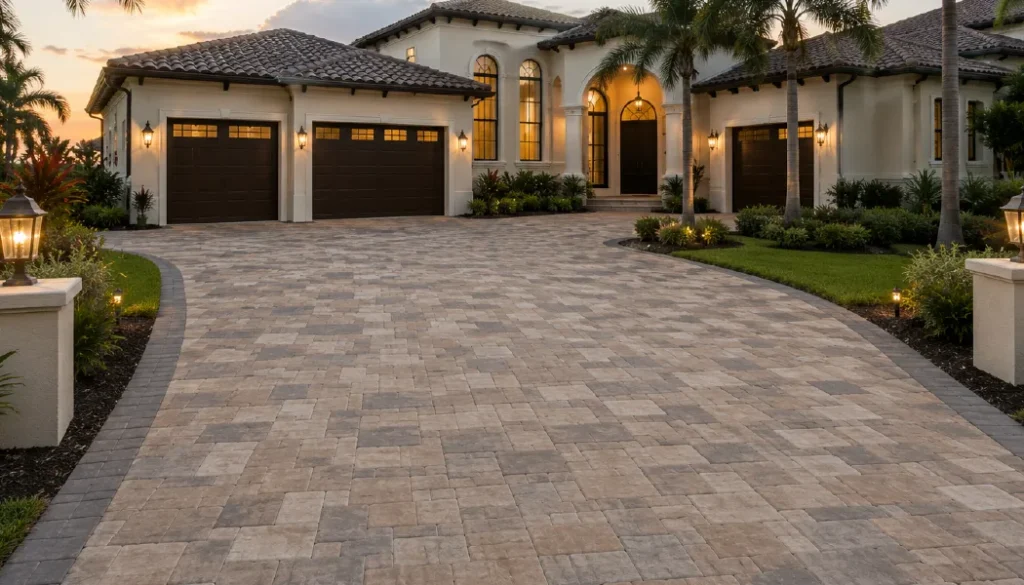
A paver driveway can be designed to complement your roof, exterior paint, garage doors, entryway, landscaping, and overall architectural style.
Borders can also be used to define the driveway and create contrast.
For homeowners investing in landscaping or exterior improvements, pavers can help make the driveway feel like an intentional part of the home’s design rather than simply a functional surface.
4. Which Is Easier to Maintain?
Both concrete and paver driveways require some level of maintenance.
Concrete may require cleaning and, depending on the finish and homeowner’s goals, sealing. Cracks should also be monitored and addressed when necessary.
Paver maintenance may include:
- Periodic cleaning
- Joint sand maintenance
- Weed prevention
- Addressing isolated movement
- Sealing when appropriate
- Removing stains
- Checking drainage
Pavers are not a maintenance-free surface.
That’s an important distinction.
Proper maintenance helps preserve their appearance and performance. Florida’s strong sunlight, rain, humidity, vegetation, and everyday vehicle traffic can all affect outdoor hardscapes over time.
The good news is that many paver maintenance issues can be addressed without replacing the entire driveway.
5. What About Weeds Between Pavers?
This is one of the most common concerns homeowners have about paver driveways.
Weeds can occasionally appear in paver joints, but they generally aren’t growing up through a properly constructed paver simply because it has joints.
Seeds and organic material can accumulate within joints over time, particularly when joint material has deteriorated or washed away.
Proper installation, joint sand maintenance, cleaning, and ongoing care can help reduce the problem.
If an existing paver driveway has significant weeds, joint loss, movement, or deterioration, it may be time for maintenance or restoration rather than assuming the entire driveway needs to be replaced.
6. Drainage Is Important for Either Option
Regardless of whether you choose concrete or pavers, proper drainage matters.
A driveway should be designed and graded so water moves in the intended direction and does not create unnecessary pooling or erosion.
This is particularly important in Southwest Florida because of the amount of rainfall we can receive during the wet season.
Standing water can indicate problems involving slope, settlement, drainage, or the surrounding landscape.
It’s also important not to assume that every paver driveway is automatically permeable.
Standard interlocking paver systems and specially designed permeable paver systems are not the same thing.
What matters is that the driveway is properly planned for the specific property.
At Master Z Pavers, grading and drainage considerations are an important part of evaluating a paver installation because what happens underneath and around the pavers is just as important as what you see on the surface.
7. Which Option Handles Repairs to Underground Utilities Better?
This is an advantage homeowners sometimes overlook.
If underground work ever needs to be performed beneath a paver driveway, individual pavers can potentially be removed to access the area and then reinstalled after the work is completed.
With concrete, accessing something underneath the driveway typically requires cutting and removing part of the slab.
The repaired area may remain visible afterward.
For a homeowner planning to stay in a property long-term, repairability is worth considering alongside initial installation cost.
8. Pavers vs. Concrete: Which Costs More?
In many situations, a basic poured concrete driveway will have a lower initial cost than a professionally installed paver driveway.
However, comparing only the upfront price doesn’t tell the entire story.
A homeowner should consider:
- Initial installation
- Site preparation
- Design options
- Maintenance
- Repairability
- Expected use
- Appearance
- Long-term ownership
- Property-specific conditions
Paver pricing can also vary substantially depending on the size of the driveway, paver selection, pattern, borders, demolition requirements, base preparation, drainage considerations, accessibility, and other site conditions.
That’s why a professional estimate based on the actual property is more useful than relying on a generic online price per square foot.
9. Which Is Better for Curb Appeal?
For homeowners prioritizing design and customization, pavers have a clear advantage.
A paver driveway can dramatically change the appearance of a home’s entrance.
The driveway can coordinate with:
- Walkways
- Front entrances
- Steps
- Patios
- Pool decks
- Landscaping borders
- Other hardscape areas
This creates a more cohesive exterior design.
It’s also one reason we recommend choosing pavers based on the entire property rather than selecting a color from a sample in isolation.
The goal isn’t simply to install pavers.
The goal is to create an outdoor surface that looks like it belongs with the home.
10. How Long Will a Paver Driveway Last?
There isn’t one lifespan that applies to every paver driveway.
Longevity depends heavily on the quality of the installation, materials, base preparation, drainage, traffic, environmental conditions, and maintenance.
A properly installed and maintained paver system can provide many years of service.
The key phrase is properly installed.
Many problems blamed on the pavers themselves actually originate underneath them.
If the base isn’t properly prepared or compacted, if drainage isn’t considered, or if edges aren’t properly restrained, movement can occur regardless of how attractive or expensive the pavers are. This is why choosing an experienced paver installer matters.
Pavers vs. Concrete Driveways: Quick Comparison
Concrete may be a good choice if:
- Keeping the initial installation cost lower is the primary concern
- You prefer a simple, uniform appearance
- Extensive design customization isn’t important to you
Pavers may be the better choice if:
- You want greater design flexibility
- Curb appeal is a priority
- You want individual areas to be repairable
- You prefer the ability to replace individual units if necessary
- You want borders, patterns, colors, and textures
- You’re investing in the overall appearance of your home’s exterior
For many Southwest Florida homeowners, these advantages make pavers an attractive long-term choice.
So, Are Pavers Better Than Concrete in Florida?
There isn’t a single answer for every property.
Concrete can provide a practical driveway surface and may make sense when simplicity and lower upfront cost are the main priorities.
However, homeowners looking for design flexibility, repairability, customization, and strong curb appeal often prefer pavers.
The most important factor isn’t simply choosing between concrete and pavers.
It’s making sure whichever surface you choose is appropriate for your property and installed correctly.
With pavers in particular, proper excavation, base preparation, compaction, grading, drainage, edge restraint, installation, and finishing are essential to long-term performance.
Frequently Asked Questions About Paver Driveways in Florida
Are pavers more expensive than concrete?
Pavers generally have a higher initial installation cost than basic poured concrete. The final difference depends on the paver selected, driveway size, site preparation, demolition, pattern, borders, drainage needs, and other property-specific conditions.
Do paver driveways crack?
Individual concrete pavers can potentially become damaged, but an interlocking paver driveway does not behave like one continuous concrete slab. If an individual paver is damaged, it can often be replaced without replacing a large section of the driveway.
Can sinking pavers be repaired?
Often, yes. The affected pavers can potentially be removed, the underlying cause addressed, the base corrected and compacted, and the pavers reinstalled. The appropriate repair depends on why the area settled.
Do pavers need to be sealed in Florida?
Sealing can help protect and enhance certain paver surfaces, but the appropriate sealing schedule depends on the paver, existing condition, previous products used, exposure, traffic, and desired finish.
Are pavers slippery when wet?
Slip resistance depends on the specific paver material, texture, finish, sealant, surface condition, and location. This is particularly important when selecting pavers for pool decks and other frequently wet areas.
Can I install new pavers over an existing concrete driveway?
Sometimes existing concrete can be incorporated into certain installation systems, but it isn’t appropriate for every property. The existing surface, elevations, drainage, thresholds, structural condition, and surrounding areas all need to be evaluated before determining the correct installation method.
Thinking About a New Paver Driveway?
Your driveway is more than a place to park your vehicles. It’s one of the first things people see when they arrive at your home.
A properly planned paver driveway can improve the appearance of your property while providing a durable and repairable surface designed around your home’s style.
Master Z Pavers specializes in professional paver installation, repair, restoration, and maintenance throughout Southwest Florida. We help homeowners understand their options, select the right solution for their property, and create outdoor spaces with attention to preparation, precision, and long-term performance.
If you’re considering replacing a concrete driveway or installing a new paver driveway, we’re ready to help.
Get a Free Paver Estimate
Call Master Z Pavers at (239) 877-5447 to discuss your project and schedule a free estimate.
Get A Free Estimate