Travertine vs. Concrete Pavers for Florida Pool Decks
If you’re planning a new pool deck or renovating an existing one in Florida, there’s a good chance you’ll eventually compare two popular options:
Travertine and concrete pavers.
Both can create a beautiful pool area.
Both are available in styles that work well with Florida homes.
And both can be used to transform an ordinary pool deck into a much more inviting outdoor living space.
But they aren’t the same material.
Travertine is natural stone, while concrete pavers are manufactured products. That difference affects their appearance, consistency, color options, texture, maintenance, price, and overall design possibilities.
For Florida homeowners, there are also practical questions to consider.
How hot will the deck get?
How will it feel under bare feet?
What happens when it gets wet?
How much maintenance will it require?
What happens if one section becomes damaged or uneven?
And which material will look best with your home and pool?
There isn’t one answer that’s right for every property.
Here’s what you should know before choosing between travertine and concrete pavers for your Florida pool deck.
What Is Travertine?
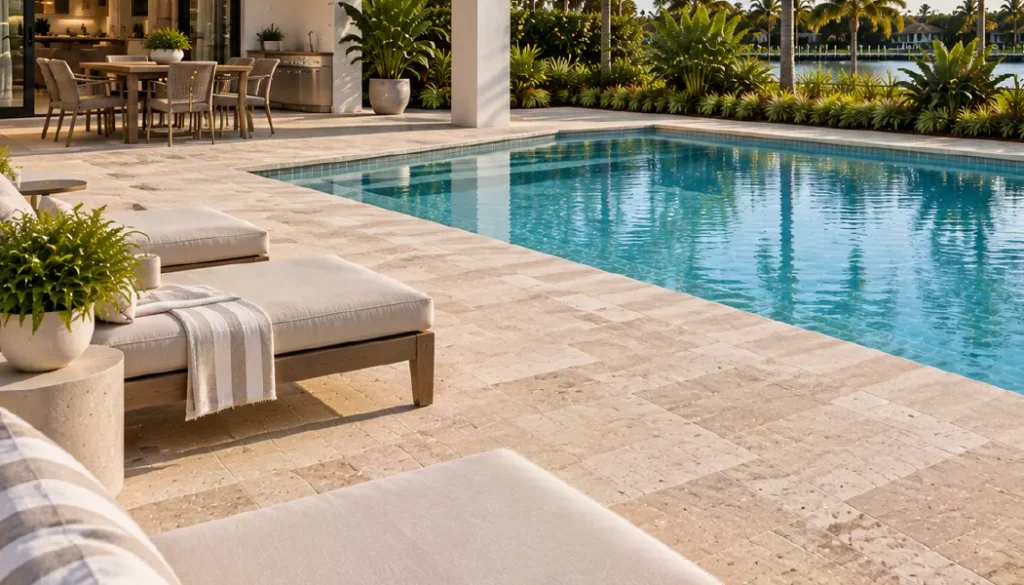
Travertine is a type of natural stone.
Because it is created naturally rather than manufactured to look identical from piece to piece, variations in color, pattern, texture, and surface characteristics are part of its appearance.
That’s one of the reasons homeowners choose it.
Travertine can create an upscale, natural look that works particularly well around pools and outdoor living spaces.
Common travertine color families include variations of:
- Cream
- Ivory
- Beige
- Tan
- Gold
- Silver
- Walnut
- Natural earth tones
The exact appearance varies because it is natural stone.
Rather than creating a perfectly uniform surface, travertine generally creates a deck with natural variation from piece to piece.
Travertine vs. Concrete Pavers: Quick Comparison
Before looking at each factor in detail, here is the basic difference.
Travertine
Often preferred by homeowners who want:
-
Natural stone
-
Organic variation
-
A high-end appearance
-
Neutral earth tones
-
A resort-style pool environment
Concrete Pavers
Often preferred by homeowners who want:
-
More color choices
-
More shapes and sizes
-
Greater pattern flexibility
-
Consistent manufactured options
-
A wider range of design styles
Neither material automatically wins every category.
The best choice depends on the property and what matters most to the homeowner.
1. Which Looks Better?
This is entirely subjective.
Travertine and concrete pavers create different visual effects.
Travertine Appearance
Travertine’s biggest aesthetic advantage is authenticity.
It isn’t manufactured to imitate natural stone.
It is natural stone.
Variation between pieces gives the surface depth and character.
Travertine often works particularly well with:
-
Mediterranean architecture
-
Coastal homes
-
Tropical landscaping
-
Resort-style pools
-
Neutral exterior palettes
-
Natural outdoor environments
It can create an elegant pool deck without requiring complicated patterns or multiple colors.
Concrete Paver Appearance
Concrete pavers offer greater control over the finished design.
Homeowners can choose from a large variety of styles and create combinations using:
-
Borders
-
Accent colors
-
Multiple sizes
-
Contrasting patterns
-
Different textures
-
Coordinating coping
This makes concrete pavers especially attractive when homeowners want to coordinate the pool deck with other hardscape areas.
For example, you might use related pavers for the:
-
Driveway
-
Walkway
-
Patio
-
Outdoor kitchen
-
Pool deck
while changing the color, texture, or pattern in each area.
Appearance Winner?
There isn’t one.
Choose travertine if you prefer the authentic variation of natural stone.
Choose concrete pavers if you want maximum design flexibility.
2. Which Stays Cooler Around a Florida Pool?
This is an important consideration in Southwest Florida.
Pool decks receive intense sunlight, and people regularly walk across them barefoot.
Surface temperature depends on several variables, including:
-
Material
-
Color
-
Density
-
Surface finish
-
Amount of direct sunlight
-
Air temperature
-
Time of day
-
Shade
Travertine—particularly in lighter colors—is often selected for pool environments where barefoot comfort is a priority.
But homeowners should avoid assuming that every piece of travertine will always be cooler than every concrete paver under every condition.
Concrete pavers are also available in lighter colors that can be appropriate around pools.
As a general design consideration, very dark outdoor surfaces can become less comfortable under direct Florida sun than lighter options.
If heat is one of your biggest concerns, compare actual samples and discuss the specific products being considered rather than making the decision based only on the material category.
3. Which Is Less Slippery?
Any pool deck should be selected with wet conditions in mind.
Water from the pool, rain, cleaning, and landscaping can all make the surface wet.
Slip resistance depends on more than whether the material is travertine or concrete.
It can be affected by:
-
Surface texture
-
Finish
-
Sealer
-
Maintenance
-
Organic growth
-
Water conditions
-
The specific product
Travertine used around pools is commonly available with textured finishes suitable for outdoor environments.
Concrete pavers are also available with many different surface textures.
A highly polished or inappropriate finish may not make sense around a pool regardless of the underlying material.
If the deck will be sealed, the sealing product and finished surface should also be selected with wet conditions and slip resistance in mind.

4. Which Offers More Design Options?
Concrete pavers generally have the advantage here.
Because they are manufactured, homeowners can choose from a broad selection of:
- Colors
- Sizes
- Shapes
- Textures
- Patterns
- Collections
That makes it easier to create highly customized designs.
You can use one paver for the main deck and another for the border.
You can create a darker accent around the perimeter.
You can coordinate the deck with the home’s entryway or driveway.
Travertine still offers design flexibility through:
- Stone size
- Pattern
- Color family
- Coping
- Borders
- Layout
But the overall palette tends to remain more naturally focused.
Design Flexibility Winner: Concrete Pavers
If having the largest number of colors and design combinations is your priority, concrete pavers usually provide more choices.
5. Which Looks More Natural?
Travertine.
Because it is natural stone, each piece can have its own characteristics.
Those differences aren’t necessarily defects.
They are part of the material.
Homeowners who want a perfectly uniform appearance may prefer the consistency of a manufactured paver.
Homeowners who appreciate natural variation may prefer travertine.
This is an important distinction to understand before installation.
If you choose natural stone expecting every piece to look identical, you may be disappointed.
If you choose it because you appreciate natural variation, those differences are part of what gives the deck its character.
6. Which Is Better for a Modern Home?
Either can work.
For a highly contemporary property, large-format concrete pavers can create clean lines and a minimalist appearance.
Neutral gray, white, beige, or other modern color palettes can work particularly well with contemporary architecture.
Travertine can also complement modern homes when the correct stone and pattern are selected.
It can create a contrast between modern architecture and natural materials.
Rather than choosing based only on architectural labels, look at the entire property:
- Exterior paint
- Roof
- Pool finish
- Waterline tile
- Outdoor furniture
- Landscaping
- Screen enclosure
- Patio
- Outdoor kitchen
The pool deck should connect visually with the rest of the home.
7. Which Requires More Maintenance?
Both require maintenance.
Neither should be considered completely maintenance-free.
Travertine Maintenance
Depending on the stone, finish, environment, and installation, maintenance can involve:
- Routine cleaning
- Managing organic growth
- Stain treatment
- Joint maintenance
- Repairing localized movement
- Evaluating sealing when appropriate
Because travertine is natural stone, products used for cleaning and maintenance should be appropriate for the material.
Concrete Paver Maintenance
Concrete-paver maintenance may include:
- Cleaning
- Joint maintenance
- Weed management
- Stain treatment
- Re-leveling localized areas
- Replacing damaged units
- Sealing when appropriate
Florida’s humidity, rain, landscaping, and year-round outdoor conditions affect both materials.
Maintenance Winner?
There isn’t a universal winner.
Maintenance depends heavily on the specific material, installation, environment, and how the homeowner uses the space.
8. Which Handles Florida Rain Better?
Both materials can perform in Florida when properly selected and installed.
But the paver itself is only part of the equation.
Proper:
- Base preparation
- Grading
- Drainage
- Edge support
- Installation
- Joint treatment
are critical.
A premium pool-deck material installed over a poorly prepared base can still develop problems.
Likewise, an expensive stone won’t correct improper drainage.
During Southwest Florida’s rainy season, water needs to move intentionally through and around the pool area.
Persistent standing water can contribute to maintenance issues regardless of which material you choose.
9. Which Is Easier to Repair?
Both travertine units and concrete pavers can potentially be removed and replaced individually.
This is one of the major advantages of using individual units instead of certain continuous deck surfaces.
If a localized section becomes uneven, a repair may involve:
- Removing the affected units
- Inspecting the area underneath
- Correcting the base or settlement problem
- Restoring the proper elevation
- Reinstalling usable pieces
- Replacing damaged units where necessary
- Restoring the joints
However, matching older material can sometimes be challenging.
Natural stone inherently varies.
Manufactured paver colors and product lines can also change over time.
For this reason, homeowners may want to keep some extra material from the original installation when practical.
10. Which Costs More?
Price is one of the most common questions homeowners ask when comparing these materials.
Unfortunately, there isn’t one number that accurately answers it.
Cost can depend on:
- Specific travertine selection
- Specific concrete paver collection
- Material availability
- Pool deck size
- Existing deck removal
- Base preparation
- Drainage requirements
- Pattern
- Borders
- Coping
- Number of cuts
- Pool shape
- Access
- Site conditions
- Labor
Travertine is often viewed as a premium material, but premium concrete paver collections can also represent a significant investment.
Instead of assuming one category is always more expensive, compare the actual materials and installation requirements for your project.
The lowest material price also does not necessarily produce the lowest total project cost.
Preparation and installation matter.
11. What About Pool Coping?
Coping is an important part of the comparison because it creates the finished edge around the pool.
Both travertine and concrete systems can offer coping options.
Some homeowners prefer matching coping.
Others choose contrast.
For example:
Travertine deck + coordinating travertine coping
can create a seamless natural-stone appearance.
A concrete-paver deck might use:
Main paver + contrasting coping
to create a more defined pool edge.
The right choice depends on the pool shape and overall design.
Coping should be considered at the beginning of the project rather than treated as an afterthought.
12. What About Saltwater Pools?
If you have a saltwater pool, tell your contractor when discussing materials and maintenance.
The pool environment, water chemistry, material manufacturer recommendations, cleaning products, and sealing system should all be considered.
Rather than assuming a generic product is suitable, use materials and treatments intended for the specific application.
This is particularly important when choosing sealers and cleaning products.
13. Should Travertine Be Sealed?
There is no universal answer for every travertine pool deck.
Whether sealing is appropriate can depend on:
- Specific stone
- Finish
- Porosity
- Environment
- Desired appearance
- Stain concerns
- Existing treatment
- Manufacturer or supplier recommendations
If sealing is considered, use a product appropriate for natural stone and the pool environment.
Do not assume that the same product used on a concrete-paver driveway should automatically be used on travertine around a pool.
14. Should Concrete Pool Pavers Be Sealed?
Concrete pavers may also be sealed depending on the product, condition, and desired result.
A sealing system may be used to:
- Enhance appearance
- Assist with stain resistance
- Support certain joint-stabilization systems
- Make routine maintenance easier
But more sealer does not automatically mean better protection.
Product selection, preparation, application, and slip resistance all matter.
15. Which Material Adds More Value?
It’s difficult to assign a universal property-value increase to either material.
A pool deck’s value to a homeowner depends on more than the material name.
Quality of installation, design, condition, usability, and how well the deck complements the property all matter.
A poorly designed premium stone installation isn’t automatically better than a beautifully designed and properly installed concrete-paver deck.
The goal should be to create an outdoor space that:
- Complements the home
- Functions properly
- Is comfortable to use
- Is appropriate for the pool environment
- Can be maintained
- Has been installed correctly
Travertine vs. Concrete Pavers: Which Should You Choose?
Here is a simple way to think about the decision.
Consider Travertine If You Want:
- Natural stone
- Organic color variation
- Neutral earth tones
- A resort-style appearance
- A premium natural aesthetic
- A material commonly associated with pool environments
Consider Concrete Pavers If You Want:
- More manufactured color choices
- More shapes and sizes
- More pattern options
- Greater design flexibility
- Easy coordination with other hardscapes
- A wide range of traditional and modern styles
But don’t make the decision based on appearance alone.
For a Florida pool deck, also consider:
Heat + Traction + Drainage + Maintenance + Installation + Budget
Can You Combine Travertine and Concrete Pavers?
Potentially, yes.
Different materials can sometimes be used to create borders, transitions, or separate outdoor areas.
But they may have different:
- Thicknesses
- Installation requirements
- Surface characteristics
- Maintenance needs
- Aging characteristics
The transition should therefore be properly designed rather than improvised during installation.
In many cases, a simpler material palette creates a cleaner finished appearance.
What Should You Look at Before Making the Final Decision?
Before ordering material, compare actual samples at the property whenever possible.
Look at them:
- In direct sunlight
- In shade
- Next to the home’s exterior
- Beside the pool
- Near existing tile
- Near landscaping
Colors can look significantly different outdoors than they do under showroom lighting or on a computer screen.
Also touch the surface.
For a pool deck, texture matters.
Imagine walking across it barefoot and wet.
Your decision should be based on the actual outdoor environment—not only a photograph.
Frequently Asked Questions
Is travertine better than concrete pavers around a pool?
Not automatically. Travertine offers natural-stone character and organic variation, while concrete pavers provide a larger selection of manufactured colors, shapes, and styles. The better option depends on your priorities.
Is travertine cooler than concrete pavers?
Surface temperature depends on material, color, finish, sun exposure, and environmental conditions. Light-colored travertine is often considered for barefoot pool areas, but specific products should be compared rather than assuming every travertine surface will be cooler than every concrete paver.
Is travertine slippery when wet?
Slip resistance depends on the stone’s finish, texture, maintenance, and any treatments applied. Material intended for pool areas should be selected with wet conditions in mind.
Are concrete pavers good around pools?
Yes. Concrete pavers can provide significant design flexibility and are available in many textures and colors appropriate for outdoor pool areas. Proper product selection and installation are important.
Which is cheaper: travertine or concrete pavers?
It depends on the specific materials and project. Travertine is often considered a premium material, but premium concrete paver products can also be costly. Compare the complete installed project rather than material price alone.
Can travertine pavers be repaired individually?
Often, yes. Individual pieces may be removed and replaced if necessary, although matching the natural variation of existing stone should be considered.
Which material is easier to maintain?
Both require maintenance. The amount depends on the specific product, environment, installation, traffic, cleaning practices, and whether the surface has been sealed.
How long will a paver pool deck last?
There is no single lifespan that applies to every pool deck. Material quality, base preparation, drainage, installation, environmental exposure, use, and maintenance all affect long-term performance.
The Best Pool Deck Is the One That Fits Your Home
Travertine and concrete pavers can both create beautiful Florida pool decks.
The decision shouldn’t be reduced to:
“Which one is better?”
The better question is:
“Which one is better for my property and the way I want to use my pool area?”
Choose travertine if the natural variation and character of stone are what you want.
Choose concrete pavers if greater design flexibility and manufactured options are more important.
Then make sure whichever material you choose is supported by proper planning, base preparation, grading, drainage, and professional installation.
Because even the best material can only perform as well as the system supporting it.
Still Deciding Between Travertine and Concrete Pavers?
Master Z Pavers installs professional paver pool decks and outdoor living spaces throughout Southwest Florida.
We can help you compare materials, colors, textures, patterns, coping, and design options based on your pool, home, property conditions, and budget.
Whether you’re building a new pool deck or replacing an existing surface, we’ll help you understand your options before the project begins.
Request a Free Estimate
Call Master Z Pavers at (239) 877-5447.
Let’s create a pool deck designed for your home, your style, and Southwest Florida living.
Get A Free Estimate